
Ray-Ban Meta Glasses: Why I, as a filmmaker, wouldn't give them up.
I am biased. I'm saying that right at the beginning so you know where you stand.
I'm a huge fan of these glasses. Not because they're perfect - they're not. But because they solved a problem I didn't know I had.
Here's my honest review after months of constant use. Not as a tech reviewer who tests the glasses for two weeks and then puts them on the shelf. But as a filmmaker who wears them every day - in the studio, on set, on the way to work, and at home.
It replaces my normal glasses
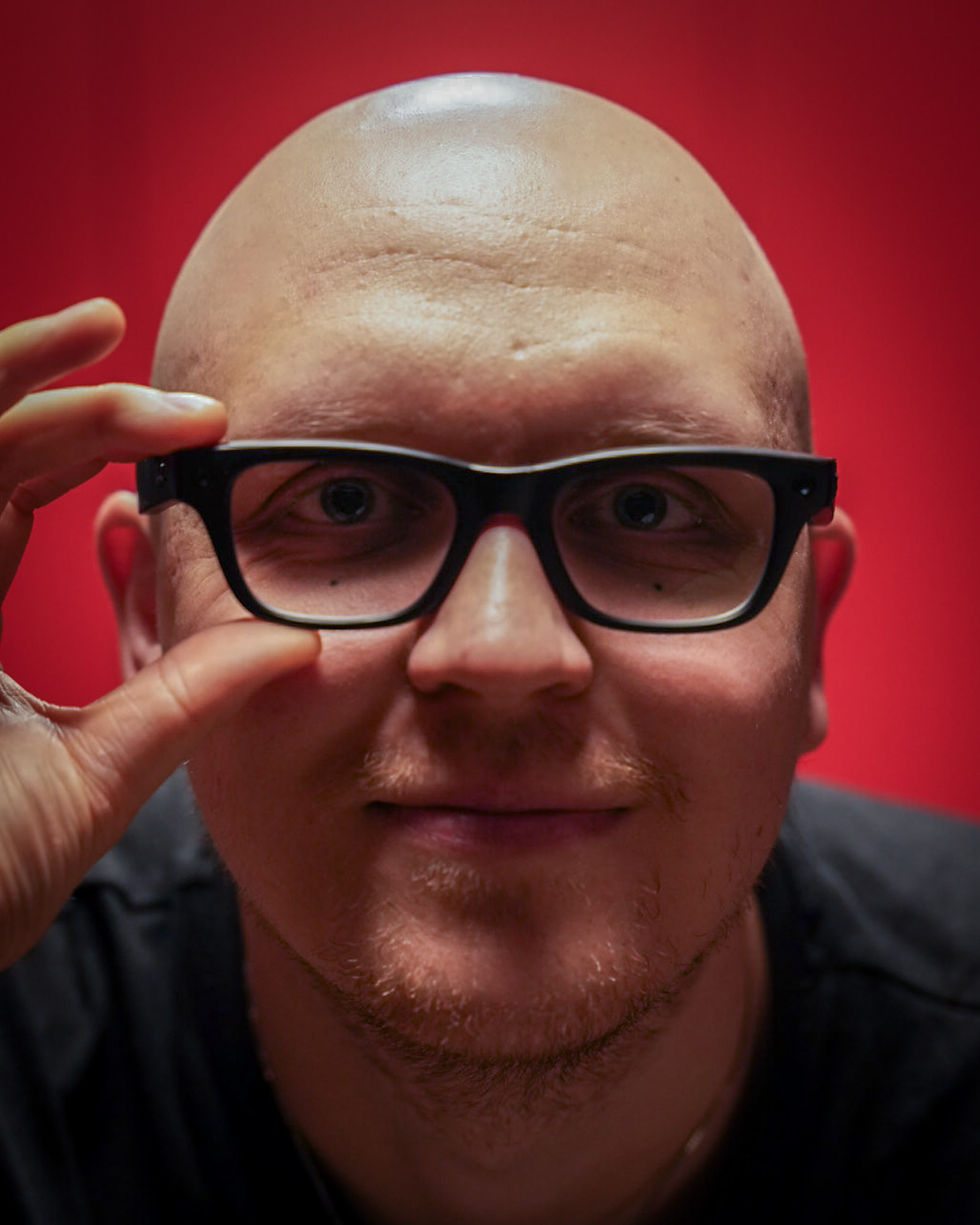
It sounds trivial, but it's the most important point. I need a prescription lens. Until now, that meant either I wear my regular glasses and don't have a camera on my head, or I put on smart glasses and can't see anything. The Ray-Ban Meta is available with a prescription lens. That means I wear them all day because they are my glasses. Not as an extra, not as a gadget, not as a gimmick - they are simply my glasses, which also happen to have a camera, speakers, and a microphone.
That's why this product works and why all other smart glasses have failed. If you have to put on a device separately, you forget about it. If it's your glasses, you always have it with you.
BTS content has never been so easy to find.
That's the killer feature for me as a filmmaker: behind-the-scenes content.
In every production - whether in the studio or on location - there are moments worth capturing. The setup, the team at work, the moment before the guest enters the room, the equipment setup. These are the moments that are invaluable on Instagram and LinkedIn because they are authentic.
The problem has always been: when you're setting up three cameras, adjusting the lighting, and wiring up the audio, you don't have a free hand to film with your phone. And by the time you remember to take your phone out, the moment is gone.
With the Ray-Ban Meta, I say "Hey Meta, record a video" - and the camera starts rolling. Hands-free. From my perspective. No interruption, no reaching for my phone, no break in my workflow. I continue setting up, and the glasses film what I see.
The video quality isn't cinematic. And it doesn't need to be. For behind-the-scenes content on Instagram Reels and TikTok, it's more than good enough. People want authenticity, not perfection. A shaky POV clip of the camera setup in the Federal Chancellery performs better on social media than a perfectly filmed B-roll shot.
Short-form content for myself or for clients has never been so quick and easy to implement as with these glasses.

Recording Time and Camera Quality: What to Expect
Now the part where we need to be realistic.
Recording time is capped at 3 minutes per clip. That sounds short - and for long takes, it is. But for my use case, it's enough. BTS clips on Instagram are 15-60 seconds long. A quick take of the studio setup doesn't need 10 minutes. And if you train yourself to think in short clips, the limit actually disciplines you: Hit record, capture the moment, stop. No mindless continuous filming where you end up sifting through an hour of footage afterwards.
What bugged me at first: You can't extend the 3 minutes. No pro mode, no override. If you need a longer sequence - setup from start to finish, a full walk-through - you have to think in multiple clips and stitch them together in post. Doable, but it's a workaround.
The camera itself: 12 megapixels for photos, video up to 3K at 30fps. No optical zoom, digital only. No image stabilization in the traditional sense - the software smooths things out, but fast head movements will get shaky.
In practice: In good light, the results are absolutely usable for social media. Sharp details, decent colors, and the ultra-wide lens captures a lot of the environment - perfect for BTS shots where you want to show the setup and the room. In low light, quality drops noticeably: noise, mushy details, slower response time.
The comparison you shouldn't make but everyone does: No, it's not an iPhone 16 Pro. The iPhone camera is in a different league - bigger sensor, better computational photography, optical stabilization. But the iPhone also isn't strapped to your head while you're setting up a tripod with both hands. The Ray-Ban Meta doesn't win on image quality. It wins on availability: You capture things you never would have filmed with your phone, because your phone wasn't in your hand.
And that's exactly the point. The best BTS clips aren't the ones shot on the best camera. They're the ones that actually exist.
Battery: Sufficient for the day
My biggest concern before buying them was the battery. Smart glasses that are dead by midday are like expensive sunglasses in the afternoon.
In practice: I easily get through the day. I open it in the morning and put it in the charging case in the evening. I don't film for hours at a time; I take photos, record short clips, listen to music, and make phone calls. With this normal usage, I still have some battery left in the evening.
If you're filming continuously for an entire day, things get tight. But these glasses aren't designed for that. They're for those in-between moments - the quick clip, the spontaneous photo, the behind-the-scenes moment.
The charging case provides extra power on the go. Open the case, insert the glasses, wait a few minutes, and you're good to go. The system works well in everyday use.
Music and phone calls: Better than expected
The open speakers in the ear hooks don't sound like AirPods. And they don't. But for music while commuting, podcasts while walking, and occasional phone calls, they're surprisingly good. At normal volume, people around you can barely hear them.
Phone calls are the unsung hero. No need to reach for your phone, no need to put on headphones. The phone rings, I tap my glasses, talk. Done. In the daily studio routine, where I'm constantly receiving calls while my hands are tangled in cables, this is a real advantage.
The sound quality during phone calls is clear on both ends. My conversation partner doesn't notice that I'm talking through glasses. This was different with older generations of smart glasses.
The AI: Usable, but not yet finished.
Meta AI is built in. You can ask the glasses what you see, have things translated, and get summaries. In practice, I rarely use this feature - but when I do, it's useful.
Where AI works: Quick questions where you don't want to take out your phone. "Hey Meta, what's the weather like today?" "Hey Meta, translate this into English." It's quick, and the answers come through the speakers.
Where it still falls short: More complex queries where the AI doesn't understand the context. And sometimes it reacts slowly or doesn't understand the question correctly in German. This will improve - Meta regularly pushes updates, and the AI's capabilities expand with each update.
For me, AI is currently a nice-to-have, not a reason to buy. The camera, eyesight, and audio are the reasons to buy.

What makes her worthwhile as a filmmaker
BTS content at the touch of a button. That alone justifies the price. Every shoot, every production, every studio visit becomes a content source - without any additional effort.
Customer documentation. I film the setup for clients who want to see what happens behind the scenes. A 30-second POV clip of the setup says more than a long explanation.
Capture spontaneous ideas. On your way to work, do you get an idea for a shot you want to try for a project? Film it briefly, mark it in the app, and implement it later. No more "I meant to film that."
Unplanned social media content. The best social media posts are the unplanned ones. The moment the equipment is laid out on the floor. The view through the RED's viewfinder. The team at work. With the glasses, you film these moments because you see them anyway.
What it's not worth
If you don't need glasses and just want it as a camera: think about it. A GoPro films better, a smartphone films better, a DJI Action Cam films better. The camera in the Ray-Ban Meta is good enough for social media, nothing more.
If you expect AI to change your life: Wait another year. The foundation is there, but the features aren't yet at a level where they alone justify a purchase.
If you need maximum video quality: Wrong glasses. This is a 12-megapixel camera in a pair of glasses, not a cinema sensor. Perfect for behind-the-scenes and short form videos, but not for anything else.
Conclusion
The Ray-Ban Meta is the first smart glasses product I didn't put away in a drawer after two weeks. Because it's not a gadget, it's my glasses. Every day, all day long, with my prescription.
For me as a filmmaker, it filled a gap that I had previously been unable to fill properly with my mobile phone and not at all with a separate camera: Spontaneous BTS content from my perspective, without interruption, without effort.
The AI isn't where it will be yet. The battery lasts if you're not filming all day. And music and phone calls work better than expected.
In short: I am and will remain with them.
Want to see what BTS content looks like on set? Follow us on Instagram - we'll be regularly posting behind-the-scenes clips straight from the set.

Comments